The elbow joint
The elbow joint
The elbow is the essential link between the shoulder and the hand. With full elbow function, the position of the hand relative to the head can be adjusted so that we can bring a fork to the mouth, wash the face or comb the hair. Pain-free function also matters for our working life, whether at a computer or in a trade, and equally for taking part in sport.
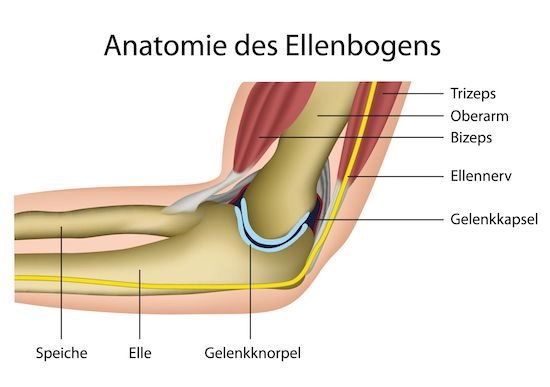
Anatomy of the elbow joint
The elbow joint brings the upper arm bone together with the two bones of the forearm (radius and ulna). Functionally it consists of three partial joints sharing a single joint capsule, in which the upper arm bone and the two forearm bones each articulate with one of the other two bones. The joint is stabilised by the bony guidance, by the muscles that cross the joint and essentially by three ligaments. The forearm can be flexed and extended at the elbow relative to the upper arm. The joint is also functionally involved in the rotating movements of the hand, pronation and supination, which are made possible in part by a complex rotational movement of the radius.
The elbow joint – function & biomechanics
A complex joint for precision and strength
Function of the elbow joint
The elbow allows:
- Flexion and extension (the main movement)
- Pronation and supination (rotating movements)
- Precise positioning of the hand
- Transfer of force from the upper arm
- Stability for everyday activities
This freedom of movement is essential for fine motor tasks and for applying force.
Biomechanics of the elbow
Joint structure:
- Humeroulnar joint: flexion and extension
- Humeroradial joint: flexion and extension
- Proximal radioulnar joint: rotating movements
Range of movement:
Flexion: 0–150°; rotating movements: 80–90°.
Stability:
Bony guidance, the muscles and three main ligaments.
Nerve supply:
Three main nerves run close to the joint.
Health & prevention
The elbow is susceptible to:
- Tennis and golfer’s elbow
- Bursitis
- Osteoarthritis
- Nerve compression syndromes
- Loose bodies in the joint
Prevention:
- An ergonomic workplace
- Regular breaks during repetitive tasks
- Strengthening the forearm muscles
- Avoiding overloading
In summary
The elbow is a complex system and essential to our fine motor skills and to applying force. Keeping it healthy in the long term depends on ergonomic working conditions, targeted prevention and treating symptoms early.
The team at Sportklinik Freiburg will be glad to help you with this.
Common conditions of the elbow
Elbow pain can have many causes – from overuse through to degenerative conditions. The most common conditions include:


Our elbow specialists
Experienced consultants caring for your elbow health