ANTEROLATERAL STABILISATION
- Method
- Anterolateral augmentation with cruciate ligament reconstruction
- Duration
- about 90-120 minutes (including the cruciate ligament reconstruction)
- Recovery time
- 6 to 12 months
For certain patients – for instance those under heavy sporting load, with pronounced rotational instability or with risk factors for a re-rupture of the cruciate ligament – an anterolateral augmentation (ALL) in addition to the anterior cruciate ligament reconstruction can make sense. This supplementary procedure specifically stabilises external rotation of the knee joint and lowers the risk of further injury.
How does anterolateral stabilisation work?
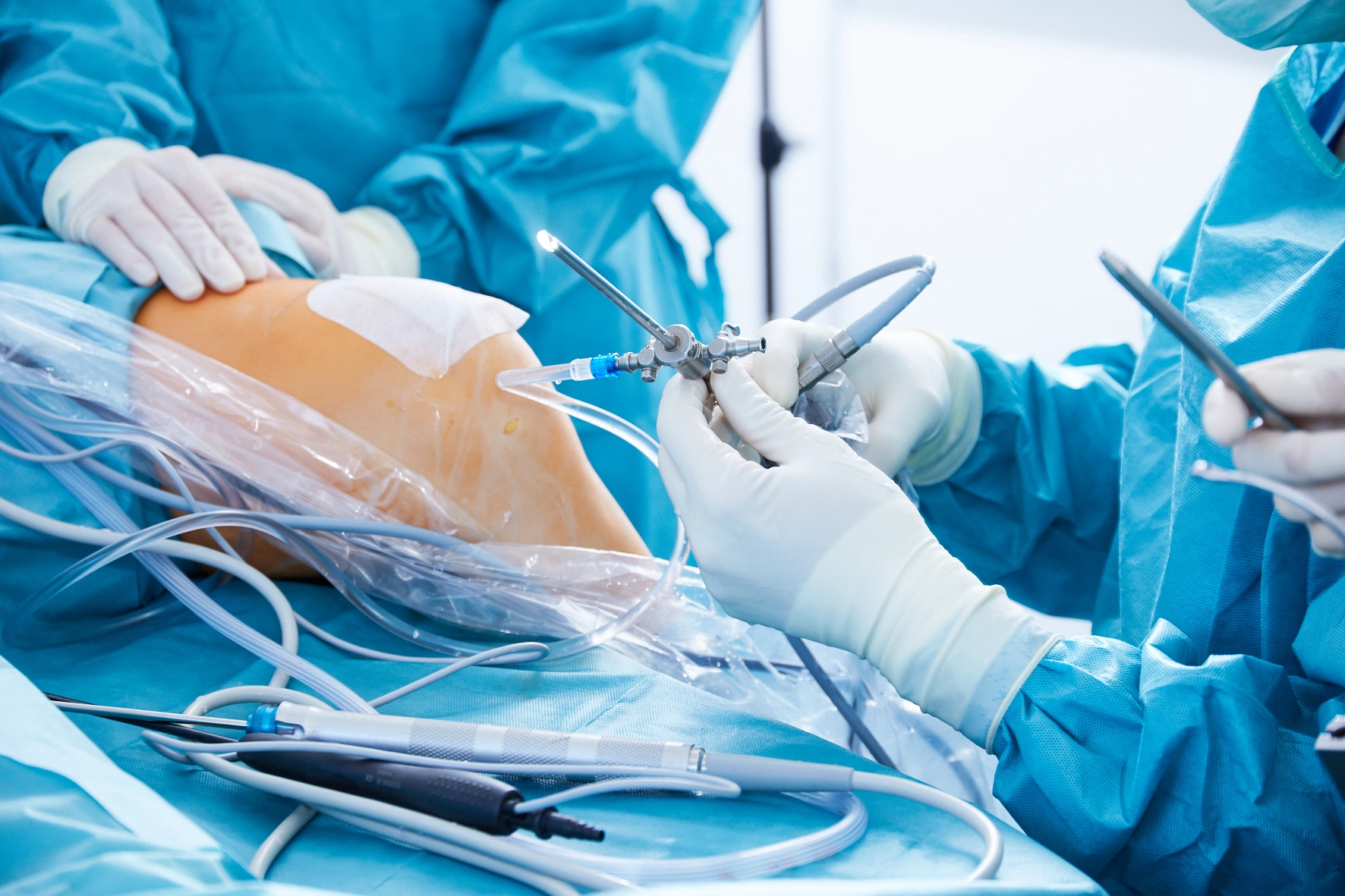
The operation is carried out in addition to the cruciate ligament reconstruction. A strip of the anterolateral structure – usually of the iliotibial band – is passed along the outer side of the thigh and, depending on the technique, joined to the thigh bone or to the shin bone. It is fixed with absorbable screws or a cortical suture-anchor system. The aim is to limit internal rotation of the tibia and to give the knee additional security during complex movements.
The tension of the band is set with the knee at about 30° of flexion and in neutral rotation, so as not to impede the natural movement of the joint. The procedure is particularly recommended for patients with a high-grade pivot shift, hyperlaxity or the demands of contact sport. ALL augmentation also offers functional advantages in revision surgery and where the meniscus is damaged as well.
Rehabilitation
Aftercare following ALL augmentation follows the usual rehabilitation plan for a cruciate ligament reconstruction. No additional restrictions are needed. What matters, though, is a <strong>delayed start to intensive rotational loading</strong>, particularly under sporting demands.
Phase I (0-6 weeks): protection and mobilisation
In the first phase after the operation the emphasis is on protecting the knee joint – above all to secure the healing-in of the graft. The anterolateral structure must not be overstretched. Early functional mobilisation is nevertheless wanted.
Aims:
- Reducing swelling and pain
- Restoring full extension of the knee
- Flexion to about 90° within the pain-free range
- Activating the quadriceps muscle
- Protecting the ALL structure from excessive external rotation
Measures:
- Partial weight-bearing with forearm crutches (about 20-30 kg) for 2-3 weeks
- Cooling, manual lymphatic drainage
- Knee orthosis depending on accompanying injuries
- Passive movement with CPM or assisted mobilisation (up to 90°)
- Isometric training: quadriceps, leg axis training
Phase II (6-12 weeks): building up load and stabilising
In this phase the load is increased slowly. The ALL structure is still remodelling – forced rotational loading should therefore be avoided. Building up muscle and economy of movement are the priorities.
Aims:
- Free full weight-bearing in everyday life
- Improving co-ordination and proprioception
- Flexion beyond 120°
- Building up the thigh and gluteal muscles
Measures:
- Closed-chain training (e.g. leg press, squats)
- Co-ordination training: wobble board, single-leg stance
- Gait analysis and optimising the leg axis
- Exercise-bike training with light resistance
- No active external rotation training of the lower leg
Phase III (months 3-6): functional build-up
The knee is now structurally consolidated and the grafts are beginning to integrate functionally. The load can be increased in a targeted way – at first in linear, later in rotational patterns of movement.
Aims:
- Symmetrical build-up of strength in both legs
- Stable control of the knee when jumping and landing
- Restoring movement across the whole range
- Everyday loading without any feeling of uncertainty
Measures:
- Free strength training (e.g. lunges, leg extension, resistance bands)
- Jump training: drop jumps, line hops, co-ordinated landing
- Sport-specific movement training without contact
- Increasing changes of direction and dynamic rotation
Phase IV (from month 6): return to sport
The aim of this phase is to restore sporting performance completely. The decision about returning to competitive sport is taken individually on the basis of functional tests.
Aims:
- Full muscular performance
- Reliable control of rotation under load testing
- No feelings of instability and no pain
- Sport-specific confidence in the knee joint
Measures:
- Return-to-sport test battery: hop tests, Y-balance, strength symmetry
- Training with simulated contact (e.g. pressure from an opponent, reaction)
- Sprints, changes of direction, landing training with correction
- Individual clearance by doctor and therapist from month 9 at the earliest